
Ceramic basins · Art basins · EAB1115W
Small details.
Real consequences.
Surface appearance and base fit are small details with practical consequences. Using EAB1115W as a surface example, this guide highlights what to discuss when agreeing the requirements for an art basin order.
One-page handout · PDF with QR code
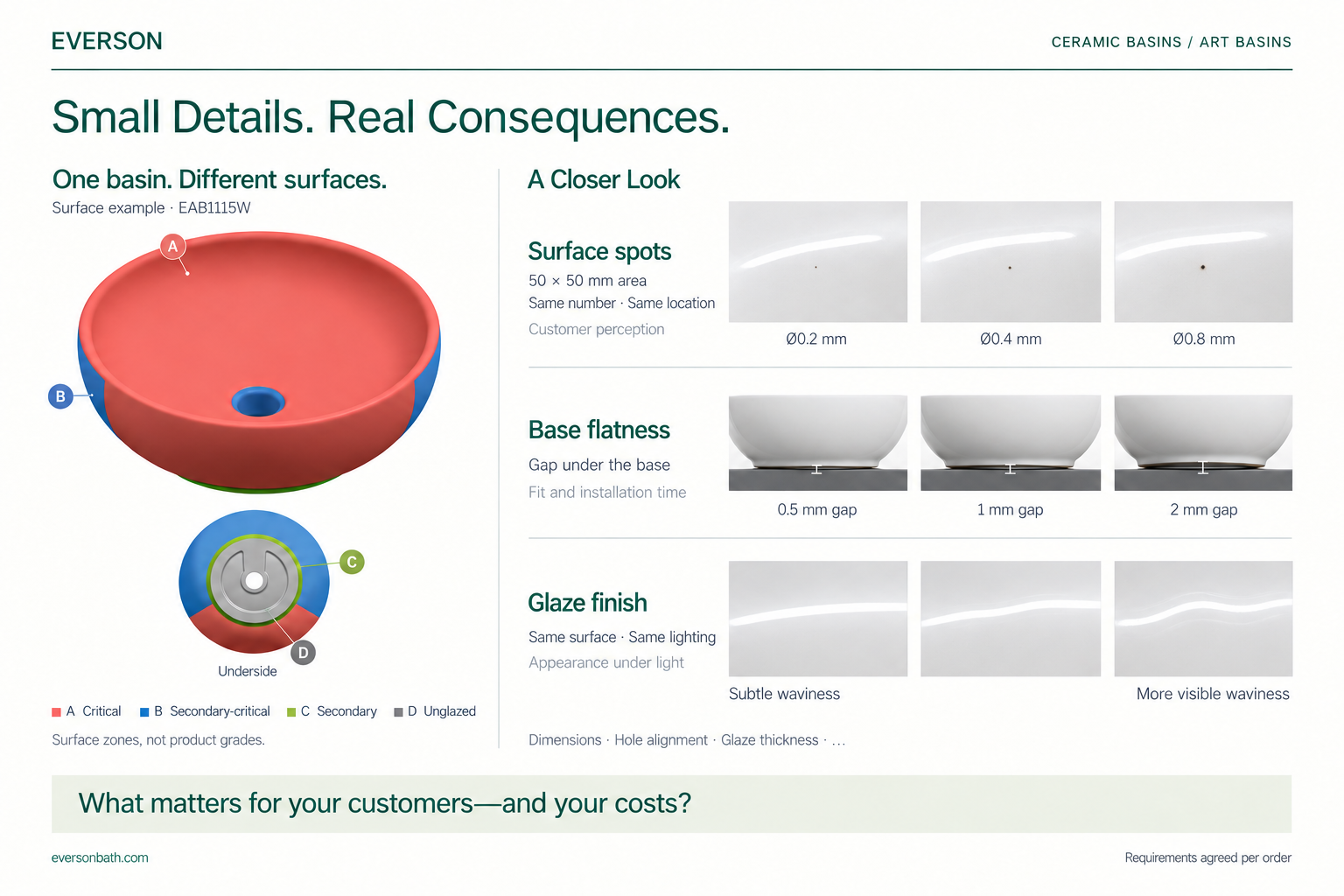
A closer look at the details.
One basin. Different surfaces.
The illustration identifies four surface zones: A — Critical; B — Secondary-critical; C — Secondary; D — Unglazed. These are surface zones, not product grades. Use them to identify where a requirement applies, including on the underside.
Surface spots: consider their size
The comparison shows spots of Ø0.2 mm, Ø0.4 mm and Ø0.8 mm in a 50 × 50 mm area, with the same number and location. It illustrates how spot size can change customer perception. Agree the size, number, location and surface area to be assessed for your order.
Base flatness: consider fit and installation
The illustration compares gaps of 0.5 mm, 1 mm and 2 mm under the base. These examples draw attention to fit and installation time. They are comparisons, not universal acceptance limits.
Glaze finish: compare under the same lighting
The images compare subtle and more visible waviness on the same surface under the same lighting. Discuss the appearance you expect and the viewing conditions used to assess it.
Look beyond the visible examples
Dimensions, hole alignment and glaze thickness also belong in the discussion. Relate the details you specify to your customers' expectations and the costs of installation, presentation and after-sales issues.
Surface example: EAB1115W. Surface zones, not product grades. The illustrated values are comparisons, not universal acceptance standards. Requirements agreed per order.
Let’s discuss your next order.
Andy Quan
Vice President Sales · Everson

Open QR image